Randomness: The Key to Statistical Validity
Select observation times and understand why randomness, independence and absence of bias are different concepts.
Updated:
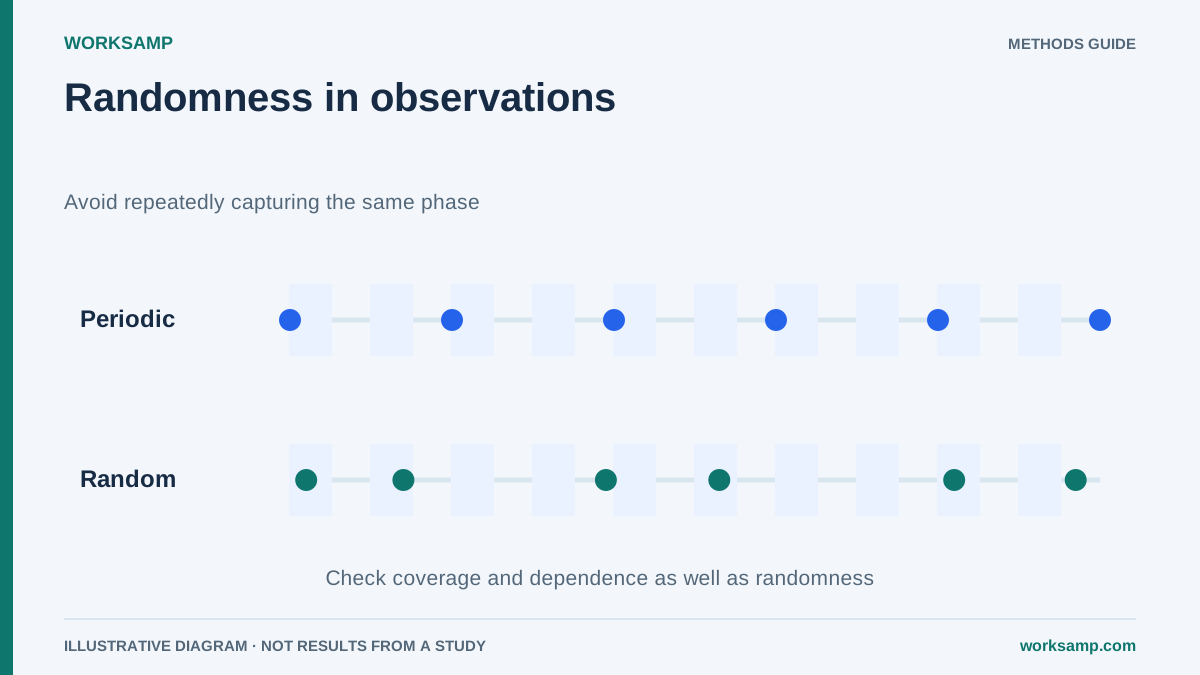
Random timing can reduce selective observation. It does not guarantee coverage of all shifts, correct classification or independent records. Those properties must be designed and checked separately.
1. Define the population
State population and horizon: a machine during planned production, a workforce during included hours or several areas. The unit may be a machine-time or person-time pair. A visit and its participations are neither measured minutes nor interchangeable units.
Selection must assign known probabilities to eligible times. If a shift is oversampled for separate analysis, use suitable weights for the overall estimate. Equal records per shift need not represent equal exposure.
2. A fixed timetable is not random selection
Fifteen-minute visits may align with cycles or breaks. A random start reduces some alignments but does not solve every periodicity. Select times within the horizon or stratify time and randomise within blocks. Document generation, infeasible routes and schedule changes.
Explain the purpose, collected data and usage limits. Unpredictability neither requires concealment nor eliminates participant reactivity. Predefine familiarisation; do not discard readings because their percentage is unwelcome.
3. Random is not independent
An hour-long breakdown can appear in several nearby readings. Machines in one line can stop together. Correlation need not bias the share but may reduce effective information and make independent-record intervals too narrow.
More days, greater spacing or cluster-aware analysis may help, depending on the process. No universal interval guarantees independence. Simultaneous rounds are possible designs: address their dependence rather than declaring them automatically invalid.
4. Plan precision
For independent simple random sampling: n₀=ceiling(z²p₀(1−p₀)/e²). At two-sided 95%, p₀=0.5 and five absolute percentage points, the starting size is 385; at three points, 1,068. These are not automatically per-employee requirements or representativeness guarantees.
Confidence describes repeated-procedure coverage under assumptions. It is not a 95% chance that a worker is productive or “95% accuracy”. After collection, estimate p̂ and an appropriate interval. Wilson addresses some weaknesses of the simple symmetric interval but does not itself repair the design.
5. Handle missed observations
Retain planned time, actual time and omission reason. Do not substitute convenient readings without a predefined rule. In a simulated example, ninety of one hundred visits are completed and eight losses are in the night warehouse. Ten additional daytime production visits do not repair that coverage gap.
Investigate the missing stratum, whether more fieldwork is needed and which periods remain unrepresented. Unobserved does not mean stopped, absent or productive.
6. Reproducibility and comparison
Record plan version, time zone, eligible days, rules, observer and deviations. A seed may reproduce pseudorandom generation; repeating it later does not ensure comparability. Compare categories, load, product, periods and conditions too.
Worksamp supports setup, random planning and capture. Review notifications and synchronisation: a sent alert does not establish a completed reading. Software does not eliminate classification judgment or confirm causes.
Checklist and sources
Check population, unit, denominator, coverage, weights, piloted categories, omissions and dependence before reporting precision. Limit comparisons to compatible contexts.
NIST planning and NIST proportion intervals. See Worksamp for the available workflow.