Industrial 360° Audit: Simulated Case and ROI
A simulated industrial audit: example data and conditions for estimating released capacity, benefits and returns.
Updated:
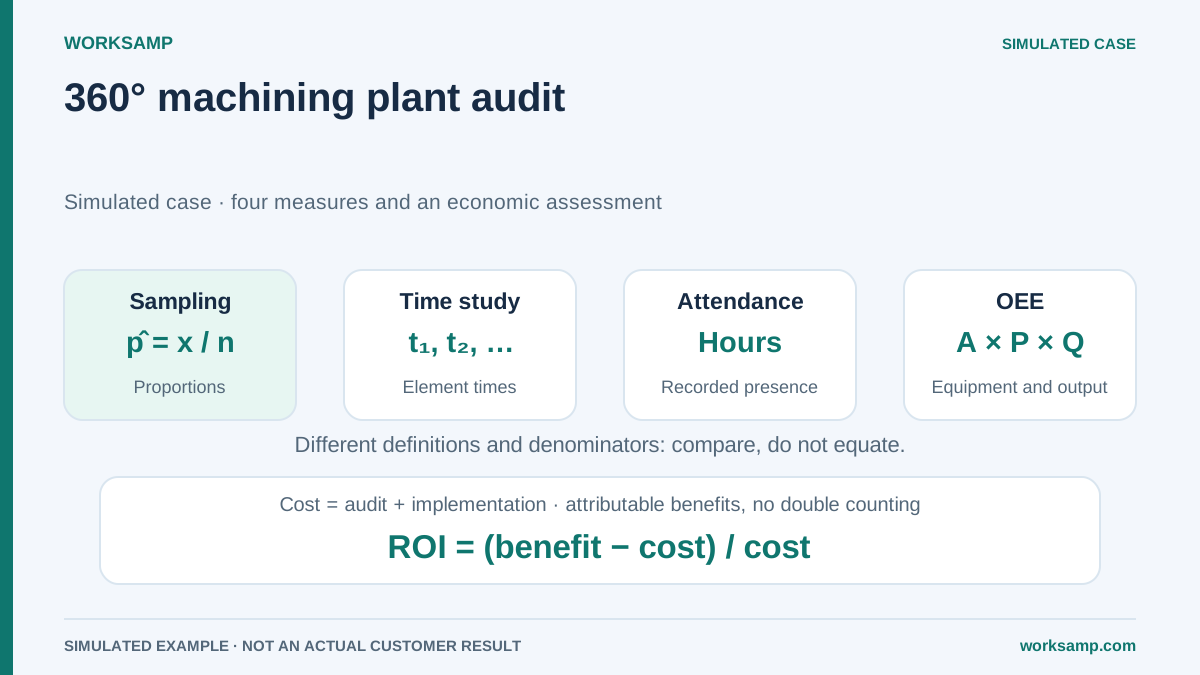
An operational review may combine sampling, time study, attendance records and equipment data. Each answers a different question. Combining them requires compatible denominators; direct-work share becomes neither OEE nor financial benefit.
Four evidence sources
| Method | Contribution | Main limitation |
|---|---|---|
| Sampling | State proportions and uncertainty | Not individual event duration |
| Time study | Element times under a defined method | Needs coverage, rating and justified allowances |
| Attendance records | Start, end and recorded events | Presence is not activity |
| Equipment data | Run time, ideal cycle and total/good units | Definitions and capture need validation |
Sequence methods around the decision. Sampling need not always come first, and no universal headcount range determines suitability.
Teaching case: four areas, three shifts
Assume a machining plant with 198 total equivalent employees across three shifts and 348,000 annual person-hours. Do not multiply those hours by three again. The scenario includes turning, milling, grinding and subassembly; all figures are assumptions, not client data.
To estimate by area and shift, plan 1,200 participations in each of twelve strata: 14,400 records. Check feasibility, weighting and dependence. The simple 95% three-point model with p₀=0.5 needs 1,068 independent records; z=2 gives 1,112 at approximately 95.45% confidence. Neither formula guarantees coverage.
Assume 46% direct work. It cannot be subtracted from reported OEE of 68% to discover “22 hidden points”: the measures differ. Investigate setup, support, breaks and waiting separately.
Check standards without diagnosing fatigue
Time elements of the selected method and review variation, mix and required sample. Thirty cycles are not universally sufficient. State whether allowances apply to normal time or total standard time.
Fewer observed pauses do not establish inflated allowances or unnecessary paid hours. Changing breaks or pace requires competent ergonomic, preventive and employment assessment. Sampling does not measure physiological needs.
Reconstruct OEE from its own inputs
A = run time / planned production time
P = ideal cycle × total units / run time
Q = good units / total units
Assume comparable components:
| Component | Initial | Assumed later |
|---|---|---|
| A | 78% | 89% |
| P | 82% | 88% |
| Q | 90% | 92% |
| Product A×P×Q | 57.564% | 72.0544% |
The difference is 14.4904 percentage points, not exactly fourteen. Two periods do not prove the audit caused improvement; assess mix, demand, quality and other changes. Across equipment, avoid averaging percentages with incompatible denominators.
Prioritise actions
A 27% waiting share in grinding may guide tool and scheduling investigation, but does not establish the constraint. Add queues, capacity and good throughput. Trial external tool preparation, sequencing and rework recording without omitting controls.
Assign owners, costs, timing and acceptance criteria. An action consuming time or training is not “zero investment.” Size follow-up for the effect that matters.
Financial case without double counting
Assume €42,500 for study and €238,000 implementation: €280,500 initially. The case assumes €84,500 of genuinely avoided overtime and €150,000 incremental contribution from units sold, without overlap. After €20,000 annual recurring costs, annual benefit before recovering investment is €214,500.
If realised in year one, net outcome after investment is −€66,000 and ROI −23.5%. With uniform net flows, simple payback is 280,500/214,500×12 = 15.7 months. A useful programme need not pay back in weeks; demand and timing must be validated.
Separately valuing recovered labour capacity does not permit adding it again to overtime or contribution. An audit guarantees neither return nor quality-standard compliance.
Tools and sources
WorkSamp supports state planning and recording. Verify any attendance or equipment system's functions separately.
NIST: proportion intervals. OEE. Spain's Occupational Risk Prevention Act.