The 'Other' Category: Risks and Management
Define and review an Other category without confusing classification uncertainty with sampling error.
Updated:
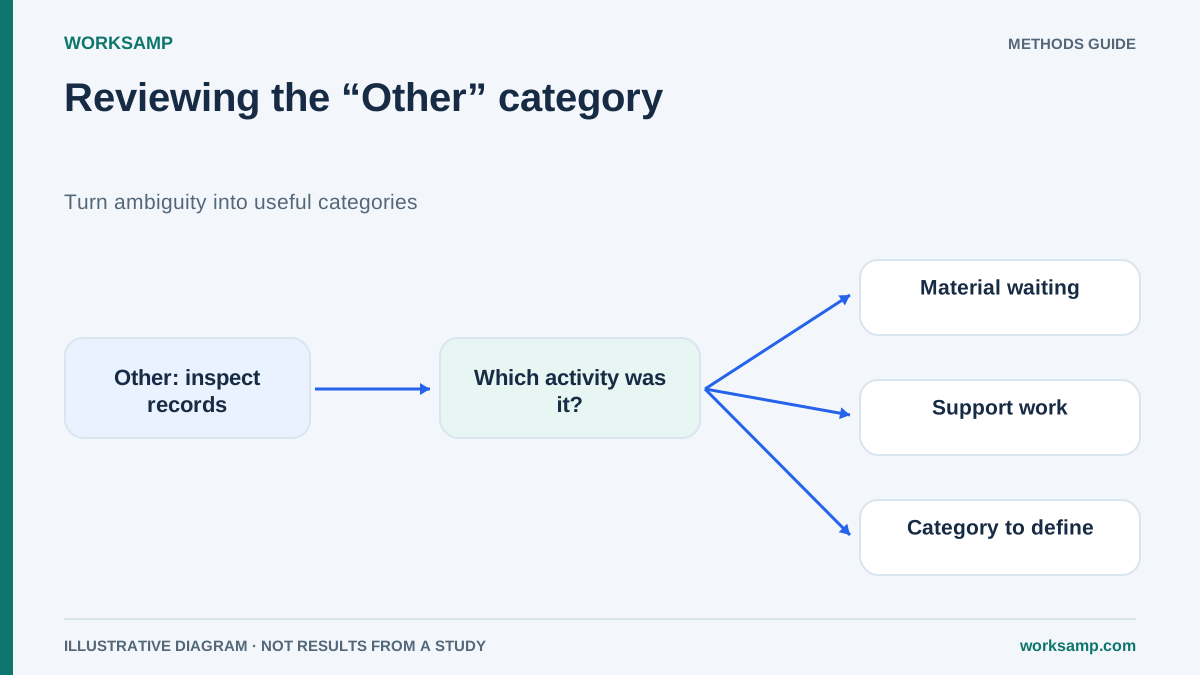
What a residual category means
“Other” can be part of an exhaustive classification. Its existence does not break p+(1−p)=1 or automatically invalidate a binomial model. The practical issue is what information its contents conceal and whether that changes across observers or periods.
Distinguish a known activity outside the list, an unobservable state, a missing record, and classification uncertainty. They are different. There is no universal legal or statistical 5% or 10% validity threshold.
Separate sampling and classification uncertainty
A large sample may estimate the recorded “Other” proportion precisely without identifying the activities inside it. There is no universal formula inflating the sampling margin according to that percentage. Changing z does not resolve missing information. NIST explains intervals for a defined category.
Teaching example: among 100 records, 65 are confirmed direct activity, twenty another activity, and fifteen unresolved. If the unresolved records might or might not be direct activity, the compatible sample share ranges from 65% to 80%. This bounds classification ambiguity in these records; it is not a confidence interval or an estimated ±4.7% error.
Investigate without inventing causes
Read notes and compare process records where access and matching timestamps permit. An alarm at the same time can guide investigation but does not prove the observed state's cause. Do not reclassify historical observations without sufficient evidence.
Directed observations can help understand difficult activities. Keep them separate from random observations used to estimate proportions. Mixing targeted visits without appropriate weighting can bias the estimate.
Redesign the catalogue
- Define the decisions each category supports.
- Describe observable states and simultaneous-task rules.
- Test actual examples with several observers.
- Add categories only where they improve clear, useful classification.
- Version the catalogue and document mappings from the previous version.
Seven categories and factor analysis of five hundred records are not mandatory. A nominal code alone does not reveal hidden activities through a Gaussian mixture.
Compare before and after a change
A lower “Other” share after expanding the catalogue may indicate improved classification, not improved production. Keep common categories when combining versions or disclose the series break. Unclassified time has not automatically been recovered.
Report the residual, its reasons, and a sensitivity assessment. Investigate when it exceeds your protocol's operational threshold, recognizing that this is an internal decision, not a mathematical guarantee or an ISO requirement.
Tools and limits
An application can organize categories and records but cannot ensure correct classification or infer root causes. Do not attribute undocumented AI suggestions, anonymous video analysis, or native integrations to WorkSamp. A useful report separates observed facts, unknown information, and hypotheses for investigation.