When NOT to Use Work Sampling
When to complement or replace work sampling: rare events, cycle times, precision and limits of observation.
Updated:
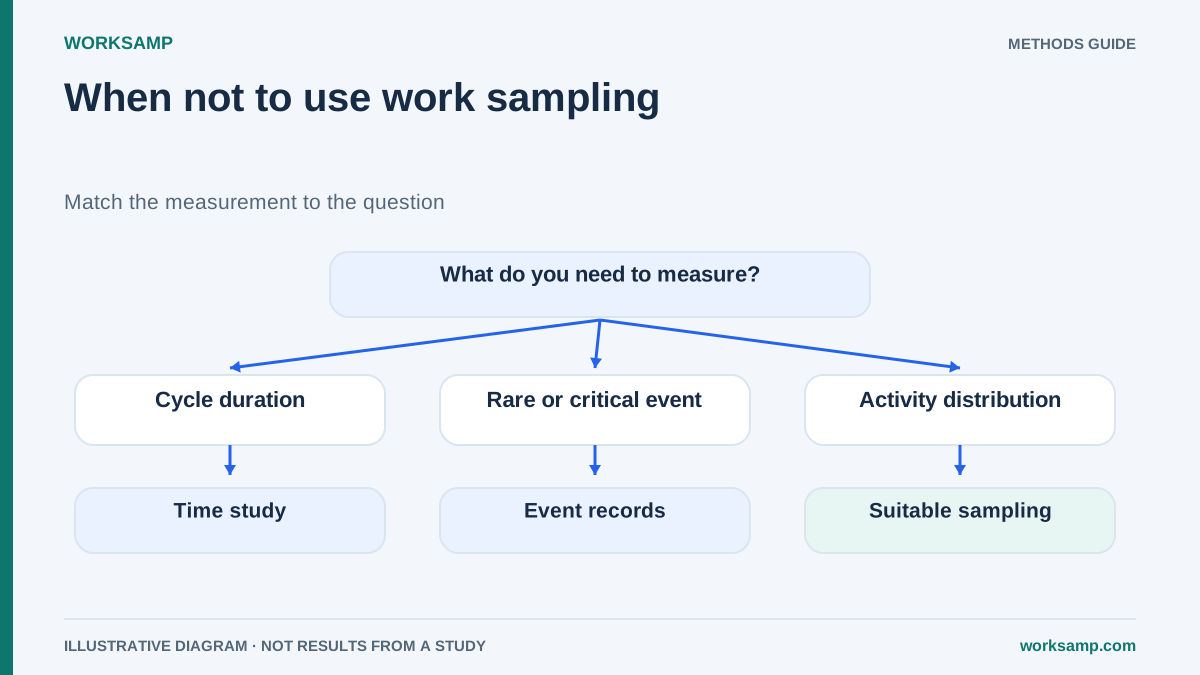
When work sampling does not answer the question
Work sampling estimates proportions of observable states. It is not inherently better than time study, event logs, or production counts. Start with the quantity needed: time distribution, individual cycle duration, failure frequency, output quality, or project results.
Continuous processes and short cycles
A fast or continuous process can still be sampled for its running-time proportion if the state can be classified reliably and the design provides appropriate coverage. A snapshot does not provide every cycle's exact duration or the sequence of brief events.
Use suitably resolved event records or time study when those details are required. Cycles shorter than thirty seconds do not automatically destroy independence; random scheduling does not guarantee it either.
Rare events: identify the probability of interest
One failure every two months describes event frequency, not the probability of finding the equipment failed at a random instant. That time proportion also depends on failure duration. Records of event starts and finishes are generally better suited to frequency, duration, and repair questions.
In a hypothetical model with state probability p=0.01 and independent readings, the probability of at least one detection is 1−(1−p)^n. Detecting a state once is not the same as estimating its proportion with useful relative precision. NIST's binomial model distinguishes these questions.
Variable and cognitive work
A job shop can use common categories and strata for product families, zones, or shifts. Classification is not impossible, but definitions need pilot testing. Looking at a screen does not reveal reasoning quality, creativity, or decision value; those require outcome criteria and context.
If classifying a state requires guessing intentions, change the variable. Do not replace a difficult measurement with an unsupported label of individual productivity.
Precision and resources
With p=0.5, z=2.576, and absolute margin e=0.02, the approximation n=z²p(1−p)/e² rounds up to 4,148 independent readings. This is a planning scenario, not a prohibition on sampling. Compare alternatives by cost, resolution, and coverage.
Privacy and safeguards
Identifiable or re-identifiable records involve personal data processing. Define purpose, lawful basis, information, access, and retention. Consent and a data protection impact assessment are not universal requirements simply because sampling is used; they depend on the processing and risk. Prior consultation with the authority is not automatic either.
The AEPD employment guide supports this analysis in Spain. Check applicable representation rights and collective agreements. Removing names does not guarantee anonymity when a unique workstation identifies its occupant.