Observation and the Hawthorne Effect: Sampling Limits
Distinguish selection bias, classification error and reactivity when observing work activities.
Updated:
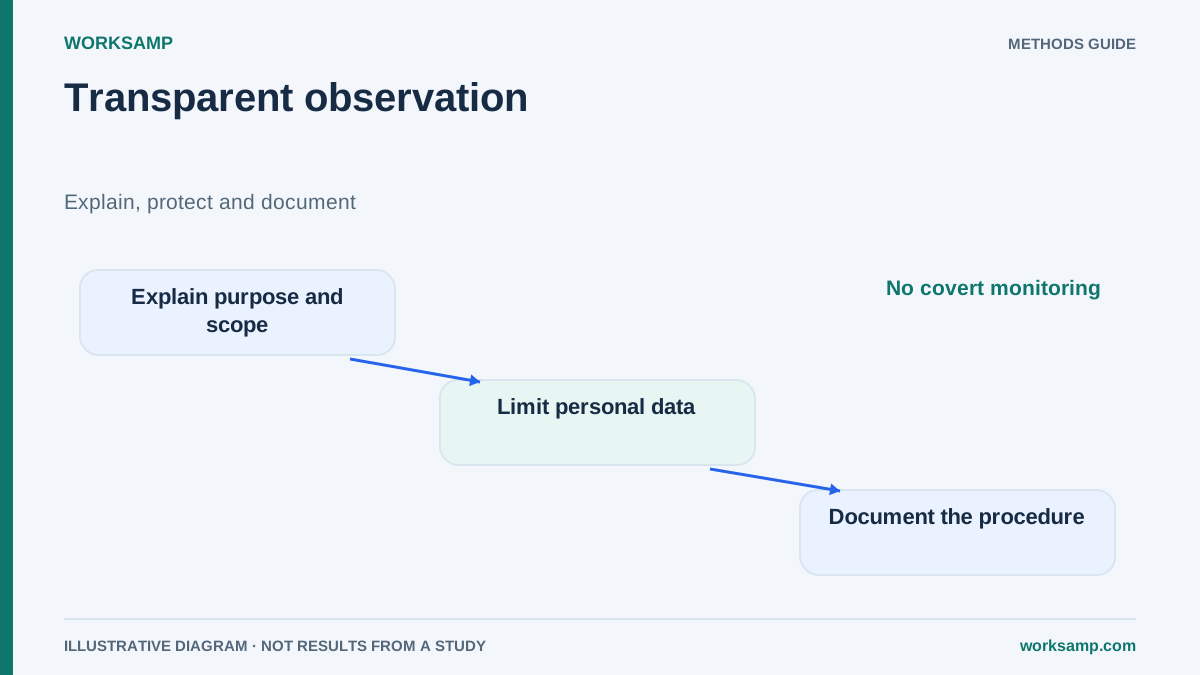
An observer's presence may influence behavior, but there is no single Hawthorne effect with a universal magnitude or direction. A study should consider reactivity without presenting hidden observation as the solution or attributing a validated bias-removal algorithm to WorkSamp.
1. Evidence and limits of extrapolation
The review by McCambridge, Witton and Elbourne describes substantial heterogeneity and limited knowledge of mechanisms and magnitudes. It supplies no universal industrial-productivity inflation rate. Participation can affect reporting, task choice or interaction, not necessarily cause everyone to work faster.
The size of an observation effect depends on context, population and study design. Without a documented mechanism and independent reference, a difference between two observation conditions cannot be used as a universal correction for plant results.
2. Random error and bias are different
If Xᵢ indicates whether a visit finds the defined activity, the proportion estimates the parameter for the covered conditions and population. Under an independent-observation approximation, the standard error is √[p(1−p)/n]. A confidence margin describes sampling uncertainty under assumptions; it does not measure every difference from an unobserved situation.
A systematic change can alter the observed parameter without necessarily destroying a binomial model or making visits dependent. Temporal or within-team correlation needs separate treatment. Increasing n does not itself remove systematic bias, classification errors or missing coverage.
3. There is no universal “distortion index” correction
Comparing open and unpredictable observations does not establish that either measures an observer-free truth. Differences may reflect shifts, workloads, products, observers or chance. This expression is therefore not used as a validated causal estimator or mandatory adjustment factor:
DI = |P_open − P_hidden| / P_hidden × 100
It is also undefined at a zero denominator and its absolute value discards the direction of the difference. A useful comparison needs a specific design and uncertainty estimates for both groups.
4. A transparent mitigation protocol
- Define the objective and unit: person-time, machine state and worker participations in one visit are not interchangeable denominators.
- Explain and agree the procedure: communicate purpose, period, categories and intended uses. Do not promise anonymity while retaining identifiers.
- Plan observation times: avoid selecting only convenient conditions and cover relevant shifts, days and workloads. Randomization is not an absolute guarantee against anticipation.
- Train and compare classifications: agreement between observers can clarify definitions but does not prove absence of reactivity.
- Record disruptions: method changes, canceled visits and reasons for non-observation belong in the findings.
- Triangulate: production and incident records may provide context. They are not automatically error-free or selection-free reference data.
Familiarization can be appropriate when specified in advance. There is no universal three-to-five-day period that guarantees disappearance of reactivity. Fisher–Yates can shuffle a finite list under suitable conditions; it neither removes causal bias nor replaces specifying selection probabilities.
5. A numerical example without an invented causal result
Assume 20,000 independent visits, p=0.5 and z=2.576 for an approximate two-sided 99% interval:
$$e\approx2.576\sqrt{0.5(1-0.5)/20000}\approx0.00911$$
The random margin is about ±0.91 percentage points. This is an arithmetic illustration of sampling uncertainty under the stated assumptions, not a measurement of reactivity. Assessing behavior change requires a defensible comparative design and consideration of alternative explanations.
6. Wrench time, OEE and product boundaries
A direct-work share depends on its operational definition and coverage; it is not individual efficiency. OEE requires planned time, run time, ideal cycle time and counts of total and good units. “Inspecting” in a sampled state is not the proportion of good products. The OEE calculation cannot be replaced by VA/NVA shares.
WorkSamp supports observation planning, capture and analysis. No Bayesian-inference module, Hawthorne corrector or automatic integration with Cronometras or Induly is established here.
7. Transparency, privacy and employment decisions
In Spain, review the Workers' Statute, risk-prevention law, applicable agreements and data protection in light of the actual design and use. The GDPR requires an appropriate legal basis and purpose limitation, minimization and transparency for personal-data processing. There is no claim here that a supposed 2025 law mandates a Hawthorne index or automatically invalidates every study without a particular statistical correction. Legal assessment requires applicable rules and facts, not a software label.
8. What the report should include
State population and period, planned and completed observations, categories, exclusions, coverage, record dependence, interval method, possible reactivity and available cross-checks with their limitations. Separate observed results from causal hypotheses and proposed actions.
Professional-support options include ASETEMYT and ProdCont. Digital recording does not transform a hypothesis into a validated correction.