Absolute Precision vs. Relative Precision: Which to Choose?
Distinguish percentage points from relative error when defining precision for an observed proportion.
Updated:
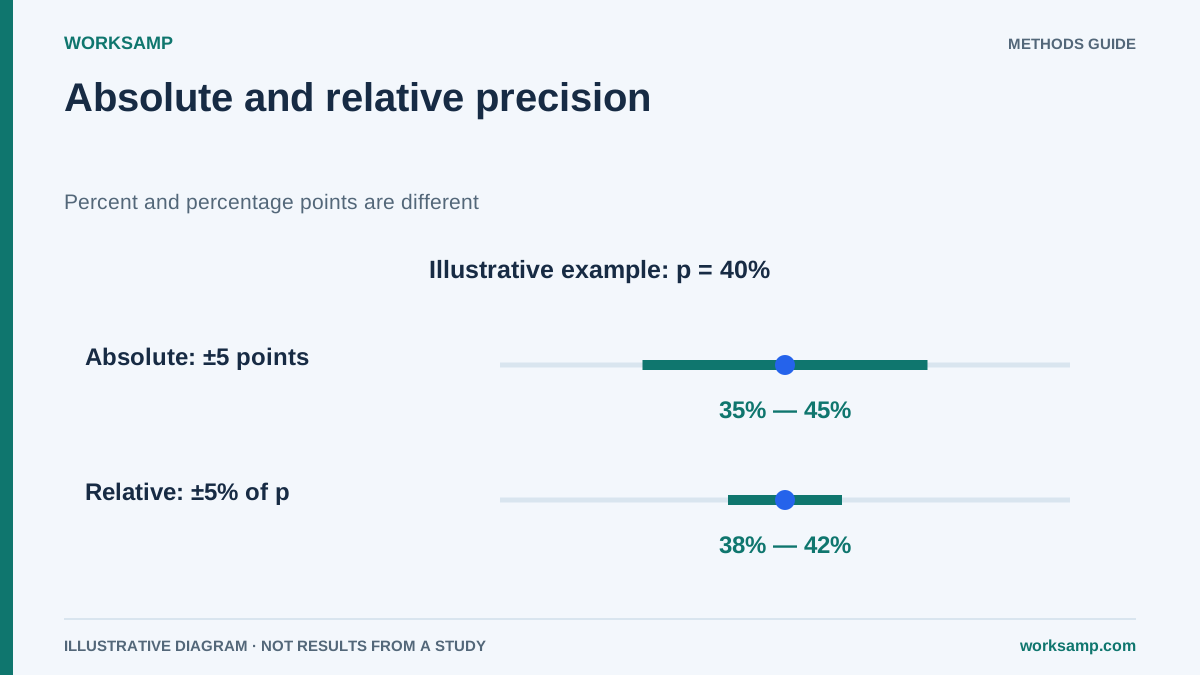
Absolute precision e is expressed in percentage points; relative precision r is a fraction of proportion p. They do not neutralise different biases. When e=r p, they express the same target under the same model.
Planning formulas
For independent simple sampling and normal approximation:n₀≈z²p₀(1−p₀)/e².
For a relative target substitute e=r p₀:n₀≈z²(1−p₀)/(r²p₀).
Round upwards and assess the design. These calculations do not guarantee a maximum error in every realised sample.
Same p, different targets
With p₀=0.35 and z=1.96:
- e=0.02: n₀=2,185 (2,184.91 before rounding).
- r=0.05: e=0.0175 and n₀=2,854.
The latter is larger because its absolute margin is narrower, not because of a paradox. At r=e/p₀≈0.05714 both formulas give the same requirement.
Rare events
For p₀=0.10:
- r=0.10 means e=0.01 and n₀=3,458.
- e=0.02 means r=0.20 and n₀=865.
Relative precision does not automatically save observations at low p: with fixed r, n rises as p falls. At high p, the same r can permit a wider e. Choose for the decision, not a more technical-sounding label.
Availability example
With p₀=0.88 and z=1.96:
- e=0.02 gives n₀=1,015.
- r=0.05 means e=0.044 and n₀=210.
The latter uses fewer readings because it tolerates 4.4 rather than two points. The future interval is not fixed at 83.6–92.4%; that is an illustration centred on the planning assumption. Observed p̂ may differ and needs its own interval.
Bias and dependence
Neither precision definition is inherently more resistant to Hawthorne effects. Timing coverage, classification, omissions and reactivity can bias either. Correlated rounds require group-aware analysis; more records are not equivalent to the same independent information.
There is no universal 200–300 record floor or ±1.5–2 point requirement for every ROI or audit. Use verified contractual conditions and a risk-appropriate design. Before/after analysis needs uncertainty for the difference; significance alone does not guarantee causation.
OEE and application
Availability precision is not automatically precision of complete OEE. Performance needs ideal cycle and counts; quality needs good/total units. A rare activity state is not a product-defect sample.
Worksamp supports statistical parameters and initial sample size with e as a proportion. Updating after twenty visits and bounding p are planning rules, not guarantees. Documented advanced analysis uses Wilson; distinguish it from the approximate symmetric margin illustrated here.
Sources: NIST size, NIST intervals, OEE.