What is Work Sampling? History and Definition
What work sampling is, what it can estimate and the design and interpretation needed for a useful application.
Updated:
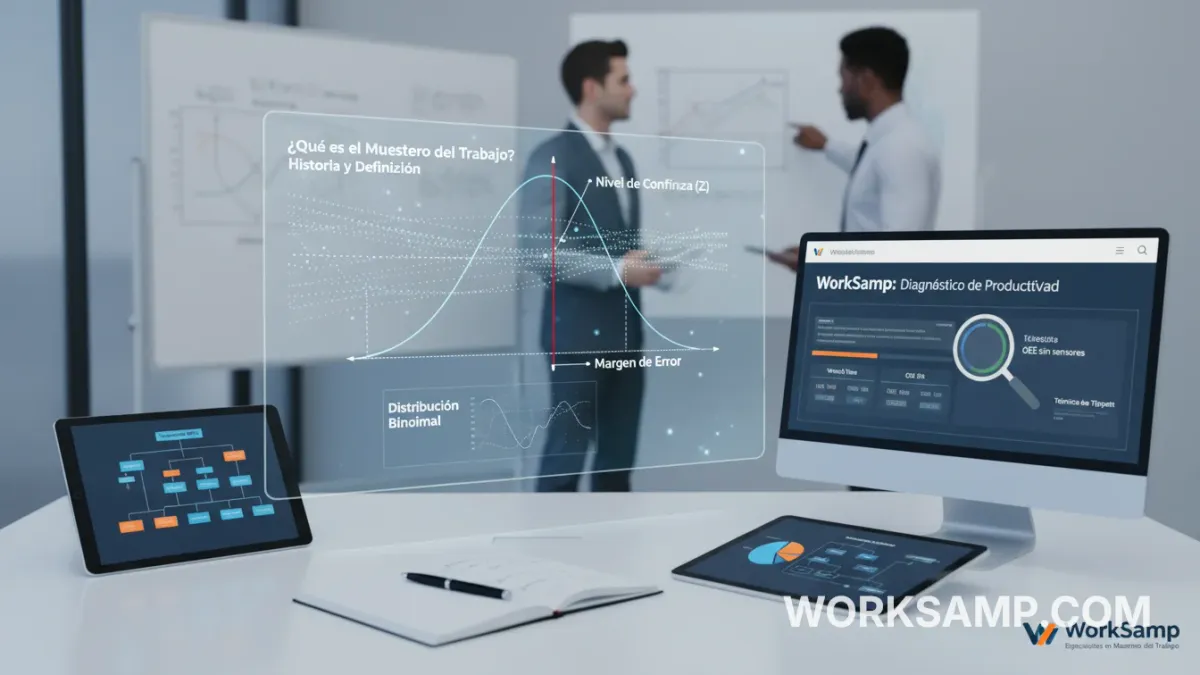
Work sampling estimates the proportion of a period spent in different activities through instantaneous observations selected under a probability sampling plan. It can study waiting, direct work, preparation, travel and machine states without continuous observation. It does not replace every sensor or time study: choose the tool for the question.
What it measures
A reading records the observed state, not the duration of that episode. Sufficient well-distributed readings estimate time proportions for the defined population and period. Measuring a specific operation may call for time study; inventory requires unit counts; diagnosing breakdowns requires technical records.
Define the unit: person-instant, machine-instant or workstation-instant. One visit recording ten people produces ten participations, not ten independent visits. People observed together may share conditions and create correlation.
Build a useful classification
Possible categories include direct work, setup, transport, waiting for material, waiting for equipment, breaks and other. Define borderline cases: conversation can be necessary coordination, and maintenance is supporting work. An activity that does not transform the product is not automatically dispensable.
Categories should cover possible states without overlap. Pilot the definitions and compare observers' classifications. Instantaneous reading reduces reliance on memory but does not remove errors or guarantee objectivity.
Planning the sample
For a proportion under a simple model of independent Bernoulli observations and a normal approximation:
$$n=\left\lceil\frac{z^2p_0(1-p_0)}{e^2}\right\rceil$$
At 95% confidence, z=1.96 and p₀=0.5, planning requires 385 observations for a target margin of 5 percentage points, or 1,068 for 3 points. This is not a universal guarantee: coverage, dependence, weighting and missing records matter. The z value is a quantile, not the confidence level itself.
A large sample does not fix an excluded shift or biased classification. Individual records remain discrete states; the normal approximation concerns the sampling distribution of the estimator when its conditions hold. Proportion intervals can use methods such as Wilson, especially near zero or one.
Worked teaching example
Assume 600 person-instant observations collected under an appropriate design:
| State | Records | Proportion |
|---|---|---|
| Direct work | 360 | 60% |
| Preparation and support | 120 | 20% |
| Waiting | 90 | 15% |
| Breaks | 30 | 5% |
The 60% estimates the aggregate, not each worker's performance. Under the simple model, its approximate normal 95% margin is 3.9 percentage points. The remaining 40% is not removable savings. Investigating the 15% waiting requires verified causes, volume, quality and supply conditions.
Fieldwork and data protection
Spread observation times across the shifts, days and workloads being represented. Avoid synchronising rounds with cycles; record delays and missing observations. Randomisation does not guarantee independence or eliminate observer reactivity. Explain the purpose, train the team and investigate behaviour changes without discarding inconvenient results.
Minimise personal data and restrict access and retention according to the purpose and applicable legal basis. Aggregating results does not automatically anonymise identifiable underlying records or guarantee GDPR compliance.
OEE and WorkSamp
OEE equals availability × performance × quality. Besides time data, it needs an ideal cycle time and total and good unit counts. Classifying people as active or inactive does not supply those components. Wrench time estimates a defined maintenance direct-work category, not all maintenance productivity.
WorkSamp supports observation planning and category recording. Calculations do not replace study design and data validation.
Frequently asked questions
Does sampling measure exact minutes? Not for individual episodes: it estimates proportions that may be converted into time equivalents using a compatible time base.
Are 385 records always sufficient? No. That result corresponds to particular parameters and assumptions for one proportion.
Is it better than a sensor? It depends on the state to capture, recording quality, total cost and privacy requirements.