Hawthorne Effect: Reducing Observer Reactivity
Understand observer reactivity and reduce it without claiming that randomisation or a large sample eliminates it.
Updated:
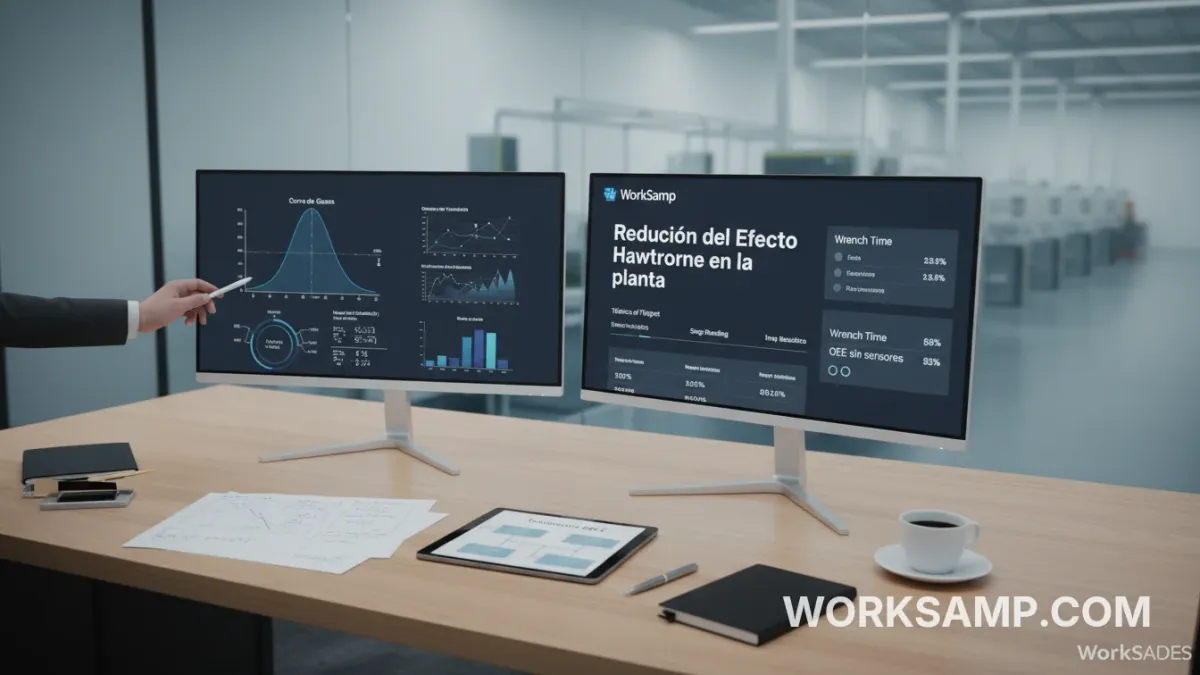
People may change their behaviour when they know they are participating in a study. In industrial settings this reactivity is often called the Hawthorne effect, but it must not be assumed to always increase output, have a fixed size or disappear through a particular technique.
The review by McCambridge, Witton and Elbourne, published in 2014, found heterogeneous findings and important limits on establishing mechanisms and magnitudes. Its studies were mostly from health sciences: they do not provide a universal correction percentage for an industrial plant.
1. Distinguish three problems
- Selection: only convenient times, stations or people are observed. Randomising part of a schedule does not correct incomplete coverage.
- Classification: observers interpret the same activity differently or assign causes they cannot observe.
- Reactivity: the measurement procedure changes what it is intended to study, for example through interaction, interruptions or expectations of appraisal.
These problems may coexist and need different controls. A random route alone does not resolve classification or establish that behaviour is identical to what would occur without the study.
2. A practical field protocol
Explain purpose and use. Communicate what is observed, how the data will be used and who can access them. Do not promise anonymity when records can identify people. Separate process diagnosis from individual conclusions the data cannot support.
Define the reading. Record the state at the intended instant, using understandable rules for simultaneous or ambiguous activities. There is no universal rule that a person takes exactly one second to react or that a millisecond reading is neutral.
Limit interference. Avoid conversations, instructions and changes to work during a reading. Never compromise safety to capture an instant: record and analyse a missed observation rather than silently replacing it with a convenient one.
Plan coverage and selection. Cover relevant periods and document how times, resources and routes are selected. Selection must fit the target population, rather than aim to catch workers by surprise. A transparent study need not announce each individual reading.
Calibrate observers. Use common examples and compare classifications. If there is a familiarisation phase, decide in advance how its data will be handled. Do not discard initial days simply because their findings are inconvenient.
3. Why a larger sample does not eliminate bias
For a simple binomial model with independent observations and a common probability, an initial approximation is:
$$n = \left\lceil \frac{z^2 p_0(1-p_0)}{e^2} \right\rceil$$
Here z is the critical value, p₀ the anticipated proportion and e the absolute margin. With z = 1.96, p₀ = 0.5 and e = 0.05, planning gives 385 observations. This is an example under those assumptions, not a universal minimum or a formula against the Hawthorne effect.
A larger sample may reduce sampling error under an appropriate design; it does not remove a systematic shift caused by the protocol. The central limit theorem does not make biased observations neutral. When measurement alters the process, an interval describes that observed process and does not automatically correct its difference from the process without an observer.
For proportion intervals and their limitations, see NIST: confidence intervals.
4. Investigating possible reactivity
Recording method changes, observer presence, interactions and contextual changes helps identify problems. Periods or independent data sources can be compared using compatible definitions. However, a difference between the beginning and end of a study does not itself identify reactivity: demand, learning, breakdowns and product mix can also change.
No fixed number of days guarantees habituation. Exclusions and comparisons should be justified by the design, not chosen afterwards to produce a preferred conclusion. If findings are sensitive to the procedure, reconsider the design and report that limitation.
5. Privacy and choice of tools
Observation without video can still involve personal-data processing. The AEPD guide to employment relationships explains obligations and legal bases to assess in that context. Choosing a technique or application does not itself establish legal compliance or replace that assessment.
WorkSamp supports observation planning and capture. Cronometras addresses a different need: measuring task durations through time study. Choice depends on the question; neither tool guarantees freedom from reactivity. A useful result documents what was measured, how, with what uncertainty and under what limitations.