Work Sampling ROI: Costs and Benefits
Calculate study costs, benefits and returns while separating released capacity, realised savings and financial assumptions.
Updated:
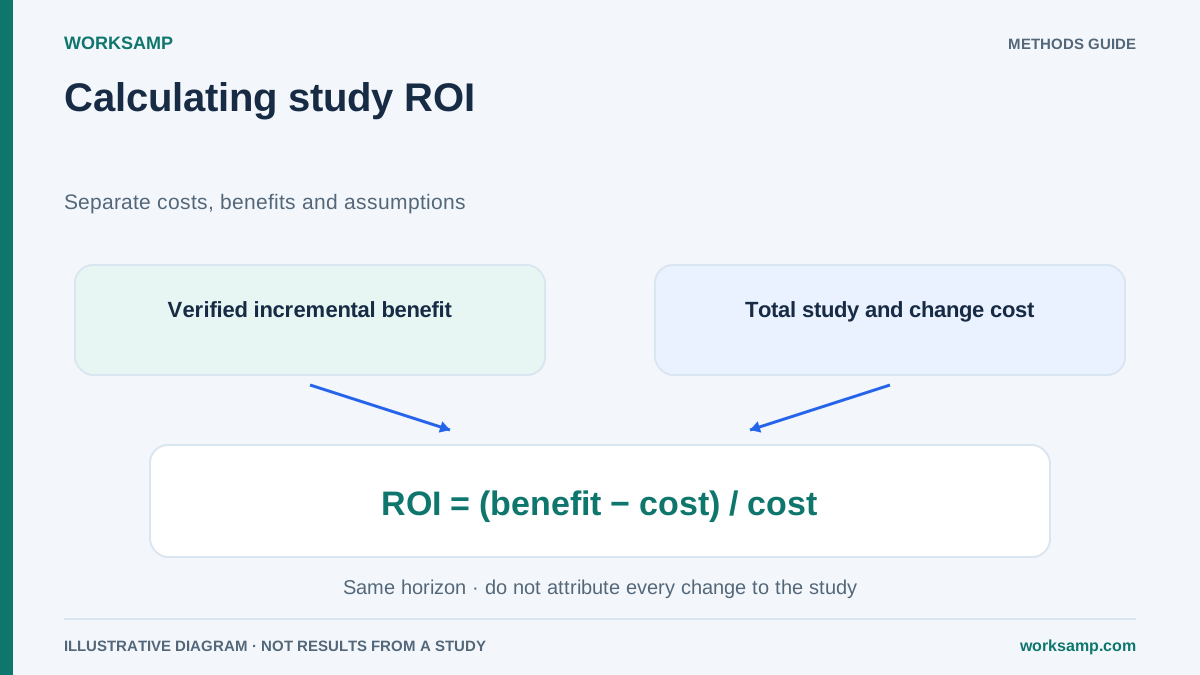
A study can reveal opportunities but does not guarantee a positive return. Results depend on the change, implementation cost and whether recovered capacity becomes revenue or avoided cost. Separate measurement cost from the whole improvement programme.
Define the calculation
For an explicit horizon, one simple convention is:
ROI = (realizable benefits − total costs) / total costs × 100
Do not call a figure “net benefit” and then subtract the same costs again. Include design, training, observation, analysis, tools, staff time, implementation and maintenance. Use verified budgets rather than unsupported market-rate ranges.
For multiple years, show cash-flow timing and consider the time value of money where appropriate. Simple payback measures when accumulated net flows recover initial investment; it is not ROI.
Four outcomes not to add without checking
- Equivalent capacity: H × absolute proportion difference. Valuing it at an hourly cost does not turn fixed payroll into cash.
- Avoided overtime: hours actually no longer paid × avoidable cost while retaining coverage.
- Additional output: good units sold × incremental contribution margin, after extra costs.
- Reassignment: verified incremental benefit of the new task, without counting capacity already valued.
More machine running time does not automatically create its hourly accounting cost as benefit. Do not add a wage again if already included in contribution margin.
Complete simulated example
Assume 30 people, 15 days and eight daily rounds. Recording everyone gives 120 visits and 3,600 participations, not 3,600 independent visits.
The study costs €8,400. Budget another €16,600 for initial implementation and €6,000 first-year maintenance: €31,000 total cost.
Waiting hypothetically falls from 31% to 20%. Across 30×1,800=54,000 annual hours, that is 5,940 equivalent hours. At €24/h this values time at €142,560; it is not yet a realizable benefit.
The business case assumes only these non-overlapping, verifiable effects:
| Annual effect | Assumption | Amount |
|---|---|---|
| Avoided overtime | 1,000 h at €36/h | €36,000 |
| Additional units sold | 10,000 units at €4 incremental contribution | €40,000 |
| Assumed realizable gross benefit | No duplicated hours or margins | €76,000 |
First-year ROI is (76,000−31,000)/31,000 = 145.2% under those assumptions. It is neither a WorkSamp result nor a promise.
For payback, initial investment is €25,000. If gross benefits and €6,000 recurring costs flow uniformly, annual net flow before recovering investment is €70,000. Simple payback is 25,000/70,000×12 = 4.3 months. Learning, weaker demand or delayed receipts alter this result.
Sensitivity and evidence
Realising only half the gross benefit, €38,000, reduces ROI to 22.6%. At €20,000 benefit, ROI is −35.5%. Document owners, timing and risks for each assumption rather than presenting a sector return range.
Compare proportions with appropriate design and uncertainty; before/after difference is not causal proof. Mix, demand or staffing changes may explain part of it. Monitor quality and safety too.
Tools and decision
WorkSamp supports observation planning and recording. Assess actual tool effort against the existing process; do not assume a 0.1% error rate, halved costs or a free plan.
Approve a study when the expected information and feasible actions justify its cost. Measurement alone creates neither savings nor compliance certification.
References
NIST: proportion uncertainty. HM Treasury: appraisal of options, costs, benefits and risks. Example calculations use original teaching assumptions.