Work Sampling in Robotic Automotive Cells
Observe robotic cells without interfering with safety or confusing human activity with automated equipment performance.
Updated:
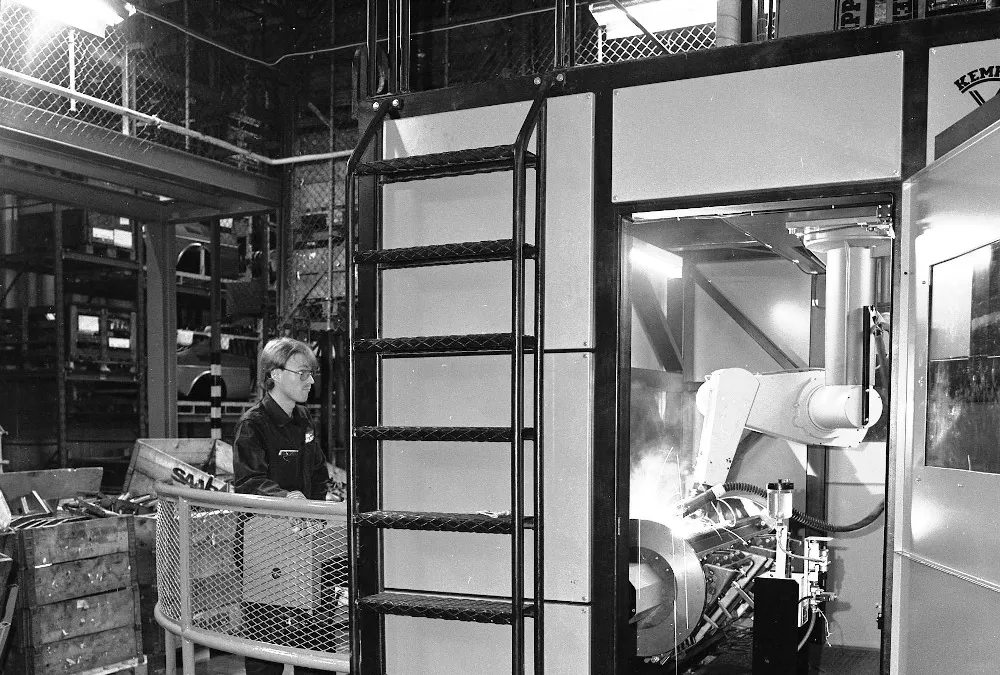
Robotic-cell studies may distinguish production, missing input, blocking, changeovers and failures. Sampling estimates their proportions when states are observable and routes safe. It is not universally superior to timing, video or PLC/MES data: validate each source for the question.
Observe different resources separately
A robot and person can work simultaneously. A taxonomy mixing “robot welding” and “operator loading” as exclusive states of one unit can duplicate or confuse time.
For robot-instant, define process execution, input waiting, output blocking, changeover, confirmed failure, planned stop and not observable. For person-instant, use loading/unloading, inspection, preparation, coordination, waiting, breaks and other. Connect context without adding both denominators into one 100%.
A light does not universally confirm state: verify its meaning with engineering. Seeing a technician does not establish breakdown, and an instantaneous reading cannot show a stop lasts under thirty seconds.
Safety and method
Never enter a cell to complete a reading. Safety staff must determine locations, permissions and protection. Sampling eliminates neither hazards nor the need to assess safeguarding categories. It does not authorise removal of delays, interlocks or inspections.
Define calendar, products, shifts and cell selection. Allocation follows exposure and objectives, not a fixed 30% night quota or universal observer count. Record visibility losses and check concentration by state; replacing a difficult cell with an easy one can bias the sample.
Size and dependence
Simple planning n=ceiling[z²p₀(1−p₀)/e²] gives 683 records with z=1.96, p₀=0.20 and e=0.03. With z=2, it gives 712 at approximately 95.45% confidence. If p is unknown, p₀=0.5 is a conservative reference for one proportion.
These calculations assume independent observations and adequate approximation. Cells sharing a line may share incidents; randomisation removes neither correlation nor reactivity. App notifications depend on permissions, device and connectivity: retain actual times.
Simulated eight-cell case
Assume 4,820 participations over three weeks, with cell-specific coverage and counts reported. At cell two, 28% of robot-instants involve confirmed waiting. Do not add human waiting to that percentage or compare it to a universal optimum.
Investigate buffer, sequencing and vision synchronisation. Increasing a buffer from four to eight parts is a hypothesis, not a general recommendation; check inventory, space, traceability and safety. Programme changes require technical assessment and validation.
If subsequent comparable records show 92 versus 115 good subassemblies daily, the increase is 25%. This does not establish that all the difference comes from these actions. An assumed €4,200 investment establishes neither ROI nor payback without incremental contribution, recurring costs and timing.
OEE and monitoring
States can inform availability investigation, but OEE also requires compatible running time, ideal cycle time and total/good units. Performance is not the active-robot percentage.
An independent arithmetic example: 92%×96%×99.5%=87.8784%; 81%×88%×99.5%=70.9236%. The 16.9548-point difference is arithmetic, not a sampling-proven gap or target benchmark.
WorkSamp supports state planning and recording. Check functions and terms; no free diagnosis, PLC integration or payback in weeks is promised.
References
NIST: proportions. OEE calculation. Spain's Occupational Risk Prevention Act.