Work Sampling in Picking and Packing
Study picking and packing using comparable categories, units and output data, with clear limits of observation.
Updated:
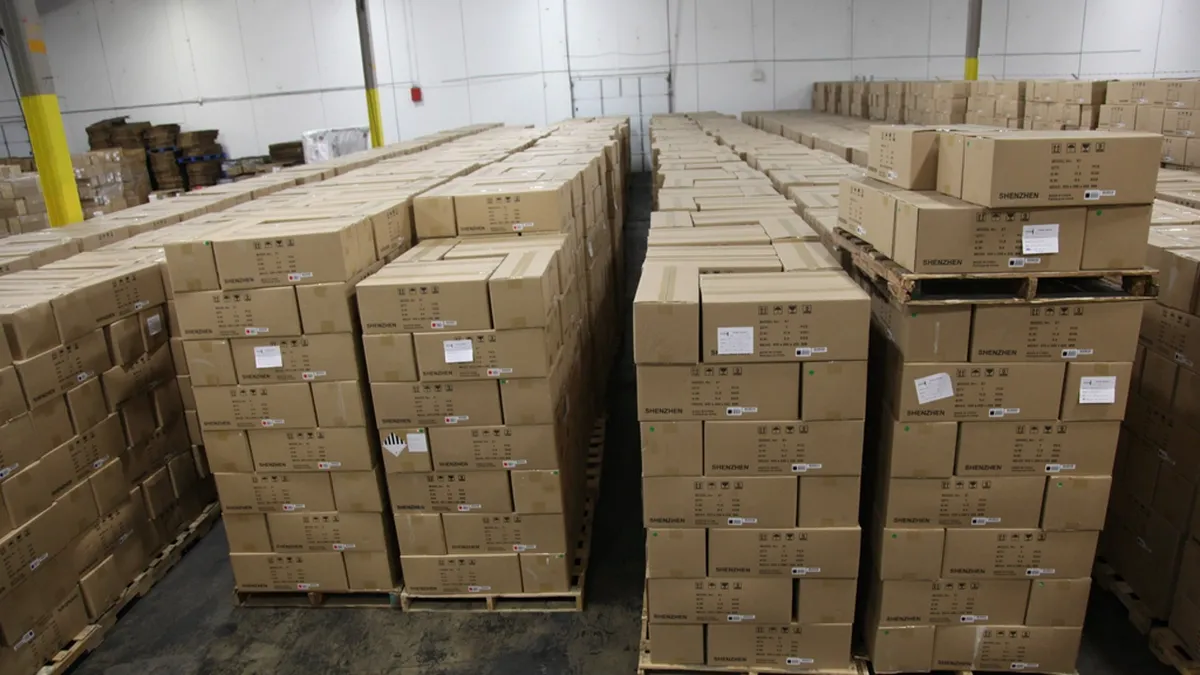
Improving order preparation and packing requires activity, volume and quality data. Sampling estimates time proportions; WMS events must be validated. Neither source inherently covers the whole process or is always superior.
Compatible categories and metrics
Define extraction, packing, consolidation, returns, system interaction, travel, search, confirmed waiting, support, breaks and not observable. Match detail to the question: eleven states are not a universal minimum.
Prevent overlap: scanning may belong to extraction or have its own category, depending on the rule. Being away from a station does not establish absenteeism; cleaning and replenishing supplies may be necessary. Attendance recording does not automatically capture microbreaks or direct work.
Clarify each KPI's denominator:
- Lines prepared per total hour: includes the agreed time scope.
- Lines per estimated extraction hour: a different, not directly comparable base.
- Errors per order/line: needs quality outcomes, not states alone.
- Cost per line: included costs / valid period lines.
A line, order and unit are not equivalent. Do not judge lines/hour using a units/hour benchmark without conversion and comparable mix.
Sample and coverage
Simple planning n=ceiling[z²p₀(1−p₀)/e²] gives 1,068 records for 95%, p₀=0.5 and three absolute points. With z=2, it gives 1,112 at approximately 95.45%. The constant four does not mean exactly 95%.
Allocate by person-hours or explicit design weights. For 50%, 35% and 15% exposure, one proportional allocation of 1,068 is 534, 374 and 160. Separate shift estimates require their own precision assessment.
A multi-person round creates potentially correlated participations. Keep actual times; a ninety-second gap does not establish independence. Cover the season and mix represented; a peak campaign is not automatically an annual average.
Teaching case: textile distribution centre
Assume a 38,000 m² centre and 1,111 validly obtained records. This is the scenario's observed count, not a universal minimum or exact outcome of the preceding formula.
| State | Records |
|---|---|
| Extraction | 458 |
| Packing | 161 |
| Travel | 242 |
| Search | 90 |
| Waiting | 71 |
| System | 44 |
| Support | 23 |
| Break | 17 |
| Not observable | 5 |
| Total | 1,111 |
The five unobservable readings are not absences. State whether results refer to 1,106 classified states or all planned readings; report losses and potential bias. Among classified readings, extraction+packing is 619/1,106=55.97%. The remainder is not automatically removable.
Investigate search through location, availability and readability. Travel may suggest slotting, but reducing it is not the sole objective if errors or congestion rise. Trial changes before assigning benefits to light- or voice-assisted picking.
Evaluate improvements without promises
Assume a later comparable direct-work share of 68.4%. This is descriptive change, not causal evidence without design and uncertainty. Moving from 85 to 118 lines/hour is a 38.8% relative increase only if lines and hours use the same definitions.
For 312 people, 1,600 annual hours and €16.50/h, 12.7 points correspond to 63,398.4 hours, or €1,046,073.60 at labour cost. This is not direct savings: verify demand, avoided overtime or hiring and deduct investment and maintenance. Lines/hour cannot be monetised without contribution, quality and saleable volume.
Monitoring and tools
Show population, period, records, weights, losses, intervals and KPI definitions. Do not require universal ±5% WMS agreement or ±3% attendance agreement: their denominators may differ.
WorkSamp supports planning and recording. Export does not establish WMS integration or independently provide logistics OEE. Complement sampling with time study for specific operations.