Comparison: Payroll Software vs. Work Sampling
Distinguish attendance records from activity studies and understand the decisions each tool can support.
Updated:
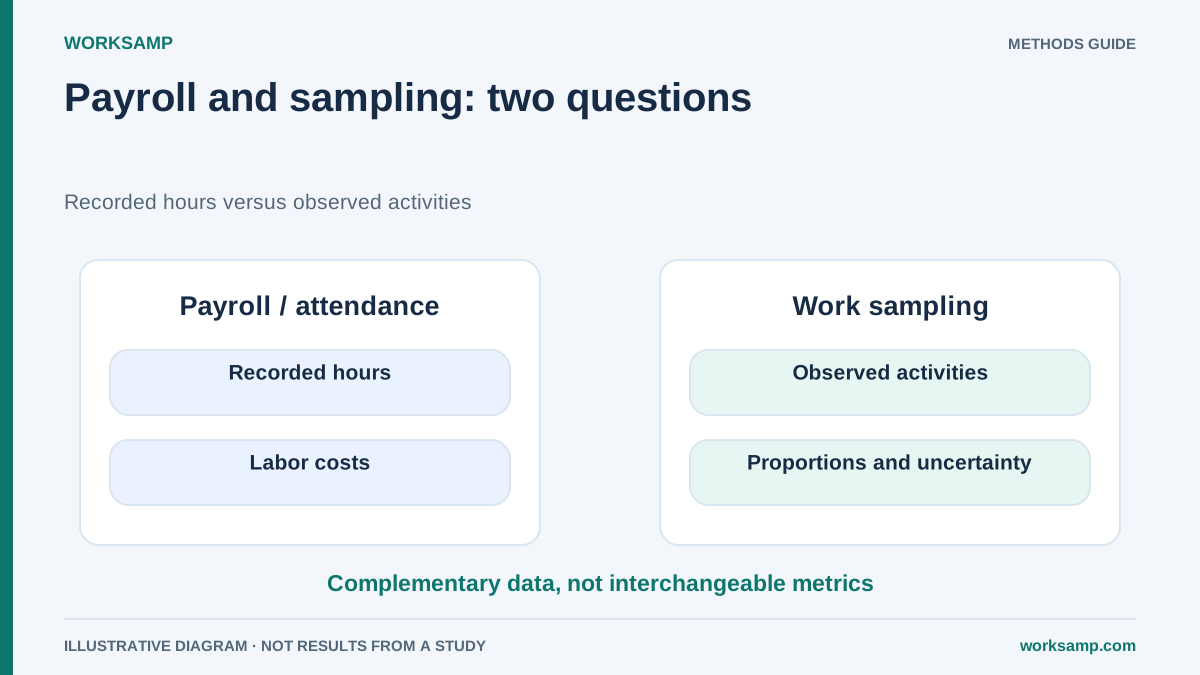
Payroll calculates compensation from contractual and financial data. Working-time records document working hours. Work sampling estimates state distributions within a defined population and period. These are distinct, potentially complementary layers; none automatically replaces the others.
Three sources, three questions
| Source | Main question | Relevant limit |
|---|---|---|
| Payroll | What amounts are due and paid? | Amounts do not explain every instant's task |
| Working-time records | What start and finish times were recorded? | Recorded attendance is not direct work |
| Sampling | What share of moments belongs to each state? | It does not record every duration or calculate salaries |
A payroll product's scope depends on modules and integrations. Some systems include task allocation; not all are blind to activity. Check actual data, validation and purpose. Digital payroll also does not guarantee compliance: inputs and applied rules can contain errors.
What an instantaneous reading adds
Define resource, period and categories. A dictionary may distinguish direct execution, preparation, waiting, travel, training, included breaks and undetermined state. Support is not automatically waste or a worker's responsibility.
A large sample alone does not ensure representativeness. Randomization reduces convenient-time selection but does not remove reactivity, misclassification or inaccessible targets. For a category under approximately independent binomial sampling:
p̂=x/n; n_plan=ceil(z²p₀(1−p₀)/e²).
With z=1.96, p₀=0.5 and e=0.03, plan 1068 readings, not 1067 after upward rounding. The margin is absolute, in percentage points. Check dependence when resources are clustered in rounds.
Define allocated cost per direct hour
In a simulated teaching example, an area has 1200 person-hours and 30000 euros of allocated labor cost. Average cost is 30000/1200=25 euros/hour. Assume a compatible study estimates two thirds of time as direct execution.
Estimated direct hours are 1200×(2/3)=800. Dividing 30000/800 gives 37.50 euros allocated cost per estimated direct hour. Using 0.67 instead of 2/3 gives 37.31 euros: those are different inputs. Retain precision in calculation.
The difference is not achievable savings, nor does support lack value. It is cost allocation using a chosen denominator. Preparation, prevention and coordination can be essential. Proportion uncertainty affects the ratio.
Do not multiply a machine-state share by workforce hours: resource, period and population must match. Where costs differ across shifts or groups, stratify and weight appropriately.
Combine data and investigate causes
Align dates, sites, shifts and units. Separate paid, recorded, study-included and estimated direct hours. Review losses and duplicates. Investigate waiting causes using process information and assess improvements through output, safety, quality and costs that can change.
A higher-cost cell is not necessarily less efficient: qualifications, task mix, shift and technology may differ. A difference does not establish its cause.
Direct-work share is not human OEE. Equipment OEE needs A=run time/planned production time, P=ideal cycle×total count/run time and Q=good count/total count. Sampled states contextualize stops but do not supply all those inputs.
Obligations and data protection
In Spain, Workers' Statute article 34.9 addresses daily working-time recording; activity sampling does not replace it. Article 64 addresses representation rights concerning work systems and studies. Assess the agreement and actual implementation.
RD 902/2020 distinguishes the pay register from pay audits: not every company has the same audit obligation. Companies preparing an equality plan include the audit required by that framework. No particular payroll product is mandatory.
Sampling is not outside regulation merely because no law bears its name. Identifiable data require consideration of GDPR and employment context. Avoid unnecessary identity matching; establish legal basis, information, access and retention. Small-group aggregates may still identify people.
Tools and sources
WorkSamp supports sampling-visit preparation and recording. Induly focuses on working time and Cronometras on durations. Automatic integration is not assumed. The ASETEMYT directory lists methods resources.