Ontological Differences: Work Sampling vs. Timing
Differences between estimating activity proportions and measuring cycle times, and when to combine both methods.
Updated:
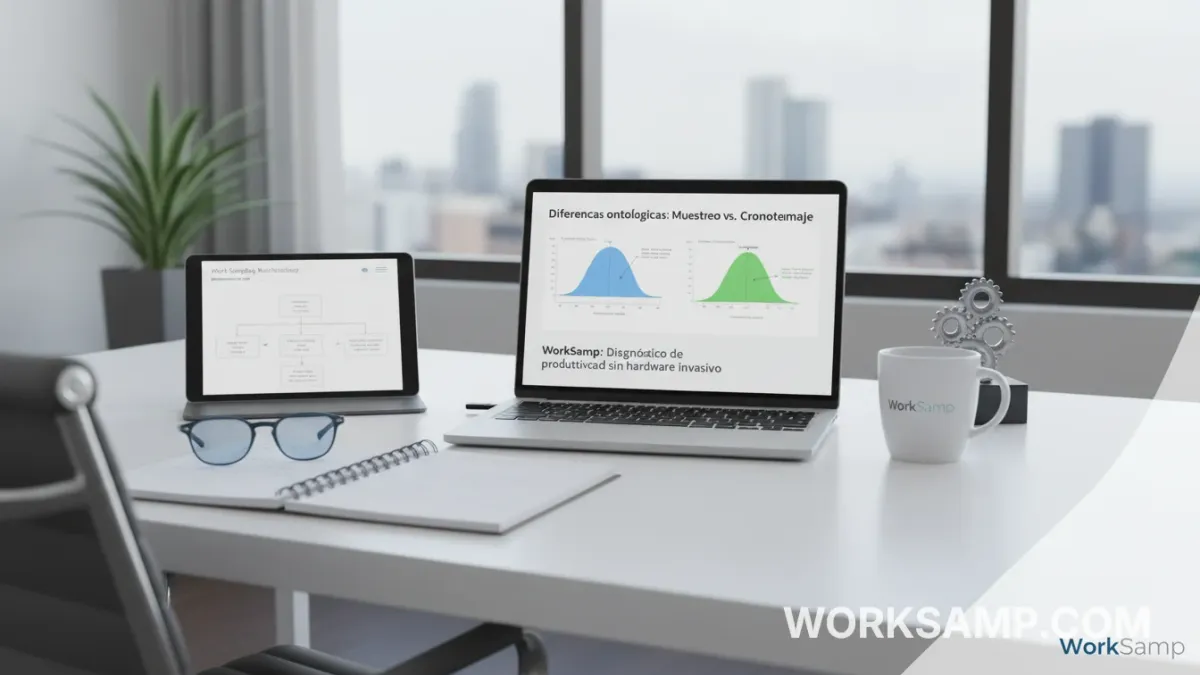
Time study measures task or element durations. Work sampling estimates state proportions from observations at selected moments. They are complementary tools: selection depends on the question, resource and required precision. Neither automatically removes human bias.
Questions each method addresses
| Question | Useful evidence |
|---|---|
| How long does a repetitive element take? | Time study with defined start and end points |
| What share of the period is waiting? | Representative state sampling |
| What happens during a particular stoppage? | Event records and detailed observation |
| What is OEE? | Consistent time, ideal-cycle, total-count and good-count data |
Cycle duration is not deterministic: material, methods, machines and conditions create variation. Sampling is not a complete record of every event either; brief events may be missed. Estimating a proportion differs from measuring each incident's duration.
Bias and observation reactivity
An analyst's presence can change behavior during continuous observation or rounds. Do not assume workers always speed up, or that an instantaneous reading removes the effect. Research on reactivity is heterogeneous and context-dependent.
Probability selection helps prevent convenient-moment selection but does not repair ambiguous categories, excluded periods or inaccessible resources. The law of large numbers concerns convergence under conditions; it does not turn systematically biased sampling into truth.
Train observers, explain scope and compare classifications. If two methods give different results, first examine denominators, tasks, periods and selection. The difference does not establish which estimate is “real” or quantify the other method's bias.
Designing a proportion estimate
For one category and approximately independent readings:
p̂=x/n; SE≈√(p̂(1−p̂)/n).
Normal-approximation planning uses n=ceil(z²p₀(1−p₀)/e²). With z=1.96, p₀=0.5 and e=0.03, this gives 1068 readings. At n=3000 the maximum approximate 95% normal margin is 1.79 percentage points under those assumptions. That establishes neither causality nor an automatic CAPEX justification.
People observed within the same round may share conditions; participations are not independent visits. At closure, calculate appropriate intervals, document losses and distinguish absolute from relative margins. For rare states, review interval methods and temporal coverage.
A simulated comparison without declaring a winner
Suppose continuous observation finds 45% direct work in selected tasks, while sampling finds 32% across a whole shift. The estimates are not directly comparable when their populations, periods and denominators differ.
If the second study contains 320 direct-work readings out of 1000 independent readings, p̂=32% and the approximate 95% normal margin is 2.89 percentage points. A 1.4-point margin cannot be inferred without a supporting sample size or design. Nor can the 13-point difference be attributed to observer pressure. A useful comparison covers comparable populations and periods and examines both measurement systems.
Combine states, durations and production
- Use sampling to locate frequent states and formulate hypotheses.
- Time specific tasks when methods and durations are needed.
- Check causes against orders, material, maintenance and context.
- Test improvements and repeat comparable measurements while considering other changes.
For OEE: A=run time/planned production time; P=ideal cycle×total count/run time; Q=good count/total count. An observed inspection share is not quality, and state categories alone do not supply performance. Sensors are unnecessary when suitable manual records exist, but are not inherently inferior.
Privacy and tools
Sampling is not automatically anonymous or legally safer. Times and workstations may permit indirect identification. Assess GDPR and applicable employment obligations, minimize data and define purpose, access and retention. Surveillance or AI restrictions depend on the technology and actual use; the name “Tippett” does not establish compliance.
WorkSamp supports visit preparation and recording, not certainty or automatic audit validation. Cronometras supports time analysis. Induly records working time, which is not task distribution. The ASETEMYT directory lists tools and specialists.
Frequently asked questions
Is time study obsolete? No. It remains useful for durations and methods analysis when the task and design support it.
Can sampling study non-repetitive work? It can estimate defined states over a representative period; it does not thereby measure every task duration.
How many readings make a study valid? There is no universal number. Precision, proportions, dependence and coverage determine the design.
Does sampling guarantee GDPR compliance? No. Assess the data and context, not merely the method's name.