Sample Size and the Central Limit Theorem
What the central limit theorem explains and why a large sample does not correct bias or guarantee independence.
Updated:
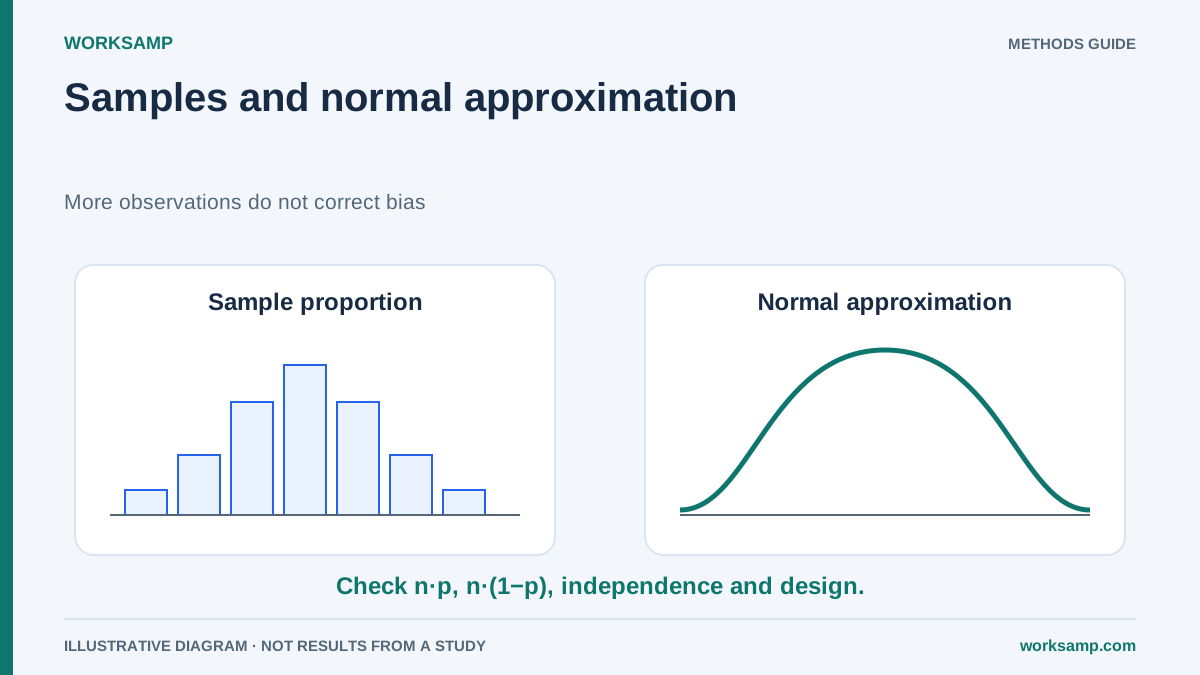
The central limit theorem does not say thirty observations suffice for every study. Under conditions, it concerns a standardised estimator's approximate normal sampling distribution. It neither makes categorical records normal nor guarantees representation.
Reading, count and proportion
For one category, Xᵢ=1 when present and 0 otherwise. Each Xᵢ is Bernoulli. Under independence and common probability p, the count is binomial and p̂=ΣXᵢ/n, with E(p̂)=p and Var(p̂)=p(1−p)/n.
The law of large numbers concerns convergence; the central limit theorem concerns approximate sampling-distribution shape. Neither repairs incomplete coverage, misclassification or behavioural reactivity.
Why thirty is not a test
At n=30 with very low p, many samples contain no events and symmetric approximation may perform poorly. Conditions such as sufficiently large np and n(1−p) are approximate diagnostics, not guarantees. Wilson or suitable binomial methods may be preferable but still need design and independence assessment.
If people in one round share a stoppage, effective information may be lower than participation count. More readings of one episode do not equal broader observed conditions.
Proportion planning
n₀=ceiling(z²p₀(1−p₀)/e²).
For two-sided 95% and p₀=0.5:
| Absolute error | n₀ |
|---|---|
| 7 points | 196 |
| 5 points | 385 |
| 4 points | 601 |
| 3 points | 1,068 |
| 2 points | 2,401 |
Express e as a proportion and round up. These are simple-model values, not universal audit minima.
Calculated example
With p₀=0.60, e=0.04 and z=1.96:n₀=ceiling(3.8416×0.24/0.0016)=577.
The unrounded value is 576.24. It does not establish in advance that final productivity lies between 56% and 64%. Calculate the interval from results using a suitable method; confidence means procedure coverage under assumptions.
Finite populations
The correction may be n=n₀/[1+(n₀−1)/M] for a finite frame of M eligible units sampled without replacement under the corresponding design. M is not automatically staff, machine or minute count. Temporal sampling needs a defined frame; with replacement or dependence, do not apply the reduction for convenience.
Calculation to campaign
Define population, period, categories and coverage; pilot; distribute selection; preserve omissions and times; analyse weights and dependence; document results. Productive share is not OEE, which also needs planned time, ideal cycle and output counts.
Worksamp supports study planning and capture. Its calculations do not independently certify all field assumptions. Consult help and Worksamp to check the workflow and reliability.
Sources: NIST planning, NIST intervals.