Stratified Sampling
Estimate proportions in stratified sampling using appropriate weights and design-consistent uncertainty.
Updated:
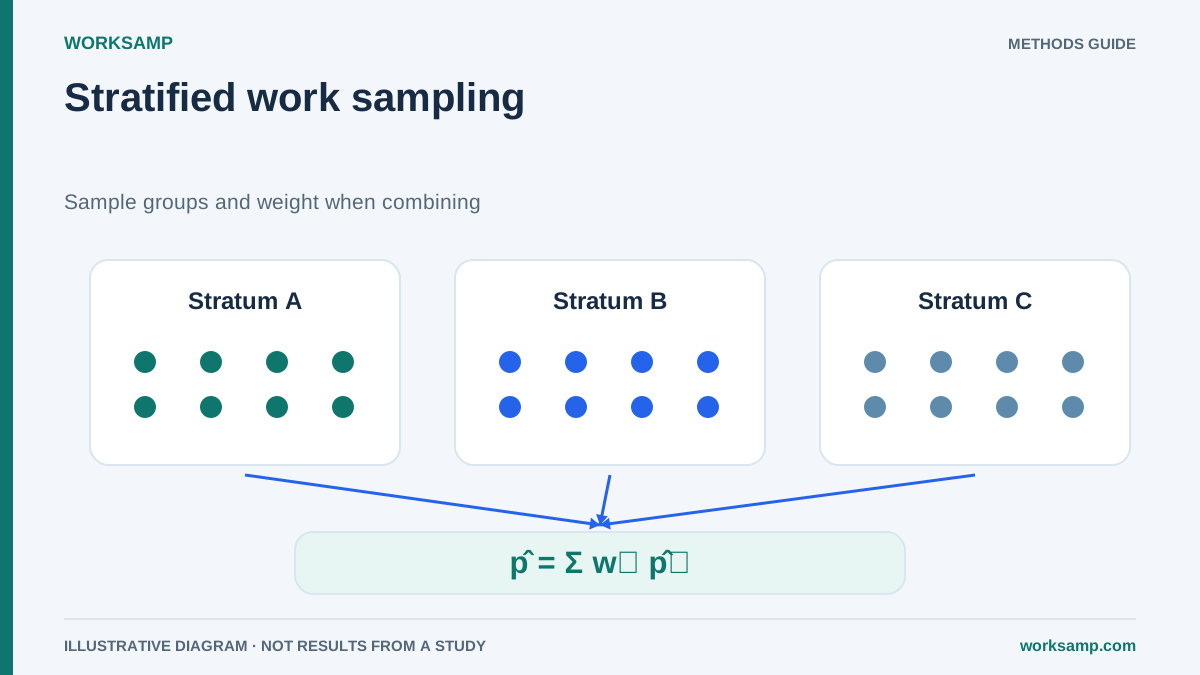
Stratification divides a population into non-overlapping groups and samples within each. It can ensure coverage of planned groups and improve precision when useful differences inform design. It is not always superior to simple random sampling or proof of within-group homogeneity.
Population and strata
For person-hours, weights must represent eligible person-hour exposure, not necessarily headcounts. Machine-time or unit studies need their corresponding exposures. Assign one stratum per unit at each instant; a worker can change areas without ambiguity if the temporal rule is explicit.
Shift, line and product family may define strata. Rework is normally an observed category rather than a stratum known before selection. Do not confuse outcome classification with sampling design.
Estimation and variance
With population weights Wₕ, p̂_st=ΣWₕp̂ₕ and ΣWₕ=1. Under independent simple random sampling without replacement within finite strata:Var(p̂_st)=Σ Wₕ²(1−nₕ/Nₕ)Sₕ²/nₕ.
Sₕ² is the finite-population binary-variable variance and needs suitable estimation. The finite correction applies only when Nₕ is the finite frame of eligible units sampled without replacement. Staff headcount is not the finite population of all possible temporal observations.
Stratification does not eliminate misclassification, omissions or round dependence. Different designs require different calculations. Positive between-group variance alone does not guarantee improvement under every allocation.
Allocation
- Proportional: nₕ approximately equals nWₕ.
- Neyman, with equal costs and suitable assumptions: nₕ proportional to NₕSₕ.
- With unequal costs: include observation costs and precision objectives.
An allocation optimal for the overall estimate may leave a subgroup imprecise. Size the relevant contrasts or estimates if shifts must be compared. The simple 1,068 calculation for p₀=0.5, 95% and three points can start planning; it does not guarantee overall precision or three points in every stratum.
Simulated example
Suppose day work represents 60% and night work 40% of person-hours. Activity estimates are 70% and 50%. The weighted total is 0.6×0.7+0.4×0.5=62%, not the unweighted 60%. Taking 100 readings in each shift does not change exposure weights.
Report each subgroup's uncertainty and a design-based interval for the total. Five records per stratum is not a universal usefulness guarantee.
Timing, dependence and changes
Select times within strata. Using the same random time across areas need not introduce bias, although it may create correlation that needs analysis. Different lists do not guarantee independence when areas share stoppages.
Preserve actual times, omissions and context. Do not make routes predictable to habituate workers or remove two or three high-result days. Predefine familiarisation and retain its data and exclusion criteria.
Decisions
Shift differences can reflect task mix or load rather than personal performance. Investigate through records and comparable trials. OEE needs ideal cycle time and unit counts; inspection or rework frequency is not its quality factor.
Worksamp supports category capture and activity review. Check that analysis handles the design's weights and groups; ordinary percentages do not establish automatic stratified variance.
Sources: Penn State stratified sampling, NIST planning, OEE.